World Market Darknet: What Happened to the AlphaBay Clone Marketplace
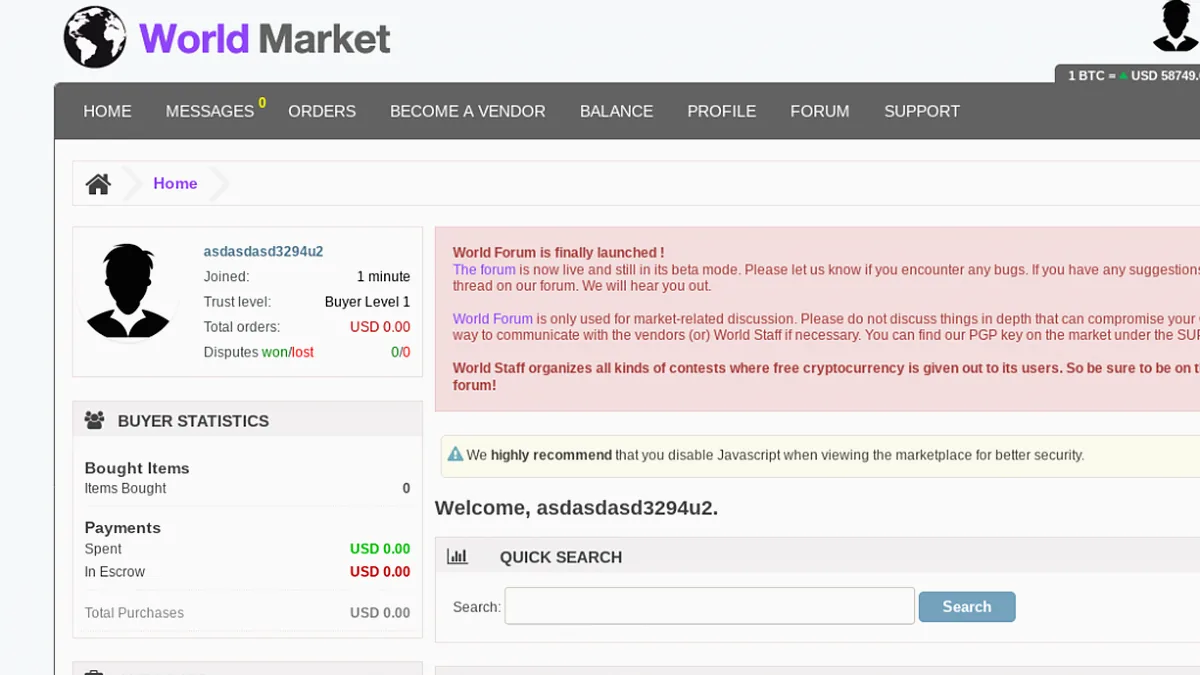
World Market darknet was a marketplace that launched in November 2020 and completely redesigned itself in January 2021 to mirror the AlphaBay and Empire Market interfaces. That design choice was both nostalgic and controversial, given that Empire had exit scammed months earlier with over 30 million dollars in user funds. The market is no longer operating, but its name continues to appear in phishing clones and fake mirrors that target users searching for the original World Market onion link. Understanding what World Market was, why it closed, and how scammers exploit its reputation helps you avoid losing cryptocurrency to impostor sites.
What World Market Was and How It Operated
World Market darknet functioned as a general-purpose marketplace that accepted both Bitcoin and Monero through an on-site wallet system. Users had to deposit funds before placing orders, and the platform required two network confirmations before balances updated. The market used an escrow system to hold payments until buyers confirmed receipt, a standard protection mechanism in darknet commerce.
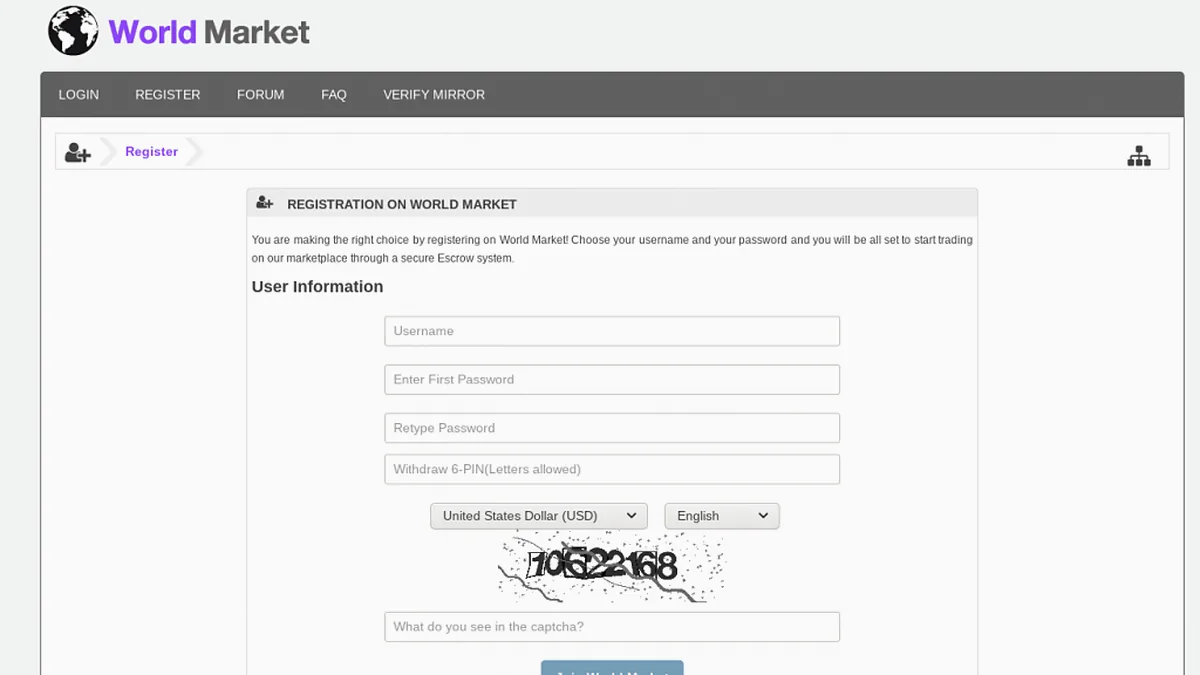
The platform prohibited weapons, child exploitation material, murder services, and prostitution, positioning itself as a drug and fraud-focused marketplace. Vendor profiles displayed feedback spanning twelve months, allowing buyers to spot recent declines in service quality that might signal an impending exit scam. Registration required only a username, password, and PIN, with a mnemonic phrase provided for account recovery.
The market's administrators openly acknowledged copying the AlphaBay layout as a tribute to Alexandre Cazes, AlphaBay's founder who died in custody in 2017. This design decision made navigation intuitive for users familiar with AlphaBay or Empire, but it also reminded many of Empire's catastrophic exit scam. The World Market url structure and interface elements were nearly identical to those earlier platforms, which later made it easier for phishing operators to create convincing fake versions.
The January 2021 Redesign and Its Timing
World Market launched in November 2020 with a different interface, then underwent a complete redesign on January 18, 2021, adopting the AlphaBay aesthetic. This timing is significant because Empire Market had exit scammed in August 2020, just months before World Market's redesign. The administrators framed the change as honoring Cazes and providing a familiar environment for displaced vendors and buyers.
The redesign split user opinion. Experienced darknet shoppers appreciated the efficient layout and the ability to view vendor statistics, product categories, and account security status from a single dashboard. Others viewed the Empire Market resemblance as a red flag, fearing that any market mimicking a known exit scam might follow the same path.
From a practical standpoint, the redesign succeeded in attracting users who had lost access to their preferred markets. The interface allowed quick comparison of vendor trust levels, refund policies, and shipping options without navigating through multiple pages. However, the nostalgic branding also created a vulnerability: when World Market eventually went offline, scammers could easily replicate its look and feel to deceive users searching for the World Market onion address.
Why World Market Closed and What Happened Next
World Market's operational status changed sometime after the April 2022 period documented in public reports, though the exact closure date and reason remain unclear. The market did not announce an exit scam in the manner of Empire, nor was it publicly seized by law enforcement in the way that AlphaBay was in 2017. It simply stopped being accessible through its known addresses.
This ambiguous closure is typical in the darknet marketplace ecosystem. Markets disappear for many reasons: voluntary shutdown by administrators who fear arrest, technical failures that make continued operation too risky, or quiet exit scams where operators take remaining escrow funds without a dramatic announcement. Without a clear explanation, users are left to verify current status through trusted forums and link directories rather than search engines.
The absence of a definitive closure narrative has made World Market's name valuable to phishing operators. Fake sites claiming to be the World Market darknet mirror or the official World Market url appear in search results and on unverified link lists. These clones capture login credentials and steal deposited cryptocurrency from users who believe they are accessing the original platform. Verifying any darknet address requires checking PGP-signed announcements and cross-referencing multiple trusted sources, not simply clicking the first result.
How Phishing Clones Exploit the World Market Name
Phishing sites targeting former World Market users follow a predictable pattern. They replicate the AlphaBay-style interface, use similar onion address structures, and appear on link aggregator sites that do not verify authenticity. When a user deposits Bitcoin or Monero, the funds go directly to the scammer's wallet rather than into an escrow system.
These clones often rank well in search results for terms like "world market onion link" or "darknet stats world market" because they use the same keywords that legitimate users search for. Some phishing operators even create fake forum posts and reviews to build apparent credibility. The visual similarity to the original World Market interface makes these scams effective, especially for users who remember the market from 2021 or 2022.
Protecting yourself requires skepticism and verification. No single onion address found through a search engine should be trusted without confirmation. Legitimate marketplaces and forums publish PGP-signed messages with their official addresses, and these signatures can be verified using the administrator's public key. If you cannot find a recent signed message confirming an address, assume the link is a phishing attempt. The Useful Resources section of this site and similar verified directories provide safer starting points than search engines or random link lists.
Context: How Darknet Markets Typically Close and What Happens After
Public law enforcement press releases from operations like Bayonet (which took down AlphaBay and Hansa in 2017) show that coordinated seizures usually result in a splash page announcing the takedown and listing arrested individuals. World Market's quiet disappearance does not match this pattern, suggesting either a voluntary closure or an exit scam without the dramatic announcements seen in cases like Empire Market.
Academic research on onion service lifecycles indicates that most darknet markets operate for less than a year before closing, and that exit scams account for a significant portion of closures. This context matters because it explains why experienced users treat any market as temporary and never leave funds in on-site wallets longer than necessary. The expectation of eventual closure shapes operational security practices across the ecosystem.
Tor Project documentation emphasizes that onion addresses provide location hiding, not reputation or authenticity guarantees. An onion address proves only that you are connecting to a specific server, not that the server is operated by the people you think it is. This technical reality is why phishing remains so effective: a fake World Market onion can look and function identically to the original, and only external verification through PGP signatures or trusted community sources can distinguish them. Users who skip this verification step routinely lose cryptocurrency to clones.
Security vendor incident reports on darknet phishing campaigns show that clones of defunct markets remain profitable for years after the original site closes. Scammers rely on new users who search for historical market names without understanding that those markets no longer exist. This pattern explains why World Market clones continue to appear despite the original platform's closure.
What Darknet Stats Reveal About Market Turnover
Tracking sites that monitor darknet stats for markets like World Market typically measure uptime, user activity, and vendor counts. These statistics show that market lifespans are short and that user migration between platforms is constant. When a major market closes, its vendors and buyers scatter to multiple successor platforms, each claiming to offer better security or lower fees.
World Market's brief operational period fits this pattern. It attracted users during a turbulent phase when Empire Market's exit scam had left many without a trusted platform, and AlphaBay's 2017 seizure was still recent history. The market's decision to adopt the AlphaBay interface was a direct response to this demand for familiarity and stability, even though stability in this environment is always temporary.
Understanding these statistics helps set realistic expectations. No darknet market has ever operated indefinitely, and every platform eventually closes through seizure, exit scam, or voluntary shutdown. Users who treat markets as permanent institutions and leave large balances in on-site wallets consistently lose funds. The safer approach is to deposit only what you need for a specific transaction, complete the purchase, and withdraw any remaining balance immediately. This practice limits exposure regardless of whether a market closes voluntarily or through an exit scam.
Safer Ways to Verify Any Darknet Address Today
Verifying a darknet address requires multiple independent sources and cryptographic proof. Start by checking the Useful Resources page on this site, which curates verified links and explains how to confirm them. Cross-reference any address with announcements on established forums like Dread, where administrators post PGP-signed messages containing their official onion addresses.
To verify a PGP signature, you need the administrator's public key, which should be available from multiple independent sources. Import the key into your PGP tool, then verify the signed message. If the signature is valid, the message has not been altered and comes from someone holding the corresponding private key. This process takes a few minutes but prevents most phishing attempts.
Never trust an address simply because it appears in search results, on a link aggregator, or in a forum post without a signature. Scammers create fake directories and post phishing links in public forums, counting on users who skip verification. If you cannot find a recent PGP-signed announcement for a market or service, treat it as non-existent or compromised. The extra time spent verifying an address is trivial compared to the cost of depositing cryptocurrency into a phishing site.
For World Market specifically, the absence of recent signed announcements and the market's unclear closure status mean that any site claiming to be World Market should be assumed to be a phishing clone. The original platform is not operating, and no legitimate successor has been publicly announced with verifiable PGP signatures.
What You Should Do Instead of Searching for World Market
If you arrived here searching for the World Market darknet platform, understand that the original market is closed and that any site using its name today is almost certainly a phishing operation. Searching for historical market names is one of the most common ways users lose cryptocurrency, because scammers optimize fake sites for exactly those search terms.
Instead of trying to access a defunct market, focus on learning the verification skills that protect you regardless of which platforms are currently operating. Practice verifying PGP signatures using test messages before you need to verify a real market address. Familiarize yourself with the Useful Resources page on this site and with established forums where administrators post signed announcements. Build the habit of checking multiple sources before trusting any onion address.
The darknet marketplace ecosystem changes constantly, and the platforms that exist today will eventually close just as World Market did. Your safety depends not on finding one trusted market, but on developing a verification process that works for any market. Start by reviewing the PGP verification guides available through the Tor Project and through this site's tutorial section, and practice the process with a test key pair before you need it for a real transaction.
Frequently asked questions
Is World Market darknet still online?
World Market is no longer operating. The market closed sometime after April 2022, though the exact date and reason for closure were not publicly announced. Any site claiming to be World Market today is almost certainly a phishing clone designed to steal cryptocurrency and login credentials from users searching for the original platform.
How can I find the real World Market onion link?
There is no legitimate World Market onion link currently available because the original market has closed. Sites claiming to offer the World Market url or official mirrors are phishing operations. If you need to verify any darknet address in the future, always check for PGP-signed announcements from administrators and cross-reference multiple trusted sources rather than relying on search results.
Why did World Market copy the AlphaBay design?
World Market adopted the AlphaBay interface in January 2021 as a tribute to Alexandre Cazes and to provide a familiar environment for users displaced by Empire Market's exit scam. The administrators believed the AlphaBay layout was efficient and well-liked by vendors. However, this design choice also made it easier for phishing operators to create convincing fake versions of World Market after it closed.
What happened to funds in World Market when it closed?
The fate of user funds when World Market closed is unclear because the market did not announce an exit scam or publish a closure statement. Markets that close without explanation may represent voluntary shutdowns, technical failures, or quiet exit scams. This uncertainty is why experienced users never leave cryptocurrency in on-site wallets longer than necessary and withdraw any remaining balance immediately after completing a transaction.
Where can I check darknet stats for World Market?
Darknet stats tracking sites that monitored World Market during its operation no longer provide current data because the market is closed. Historical statistics from that period show typical patterns of short market lifespans and user migration between platforms. For current marketplace information, focus on verified forums and link directories that confirm operational status through PGP-signed announcements rather than relying on outdated statistics.